

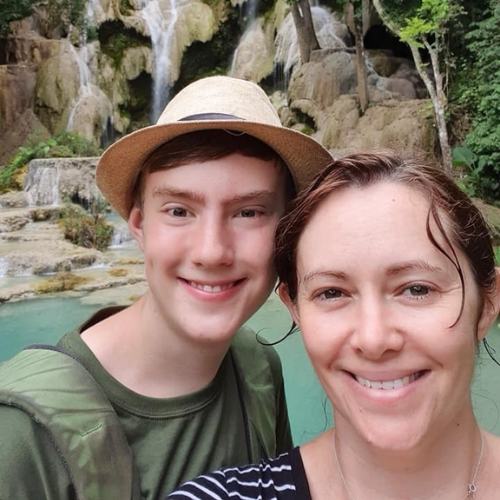
After losing her son Tobi to suicide, Katherine found The Push-Up Challenge during one of the hardest periods of her life.
Six years later, it remains a way to honour his memory, open up conversations about mental health and suicide, and raise funds for life-changing support services.
Katherine has been taking part in the Push-up Challenge for six years. Her first year came during an intense period of grief, just a few months after she and her husband lost their only son, Tobi, to suicide. He was 16.
“So it was quite recently after we lost him in 2021, neither of us were working. We were at that stage of acute grief. I've never been able to find words to describe that grief, really. Tobi was 16 when he died. He was our only son. We weren't lucky enough to have any other children. And so, yeah, it just completely ripped us to shreds.”
For Katherine, taking part in the Challenge gave her a way to keep moving.
“It just seemed to be a good way to actually just start moving or to do something. You sort of have this feeling that you want to do something. If that makes sense”
Losing someone to suicide can be deeply isolating for the family members left behind, particularly because of the stigma that still surrounds it. Friends and family are often unsure how to support them, and communities may not rally around them in the same way they do after other tragedies.
“Grief from suicide is a very isolating type of grief. We lost a lot of friends after we lost Tobi. Mostly because they didn't know how to talk about grief and didn't know how to talk about suicide. The good ones stayed, were there for us but we did lose a lot.”
“You know, if we lost a child to any other condition, it's all over the news. But we lose someone to suicide: silence, you know, there's nothing. And so I think the more we talk about it, the more we keep, pushing for better, the more we talk, the less people feel the stigma”
Katherine is grateful for the friends who pushed through the discomfort. Little by little, she began to move forward.
“I think suicide is probably the worst form of grief, but you really just have to get up every morning. You have to go outside every day. You have to eat roughly three times a day and try and get some sleep. You do that for enough days in a row, things start to become over a long period of time, just that little bit easier. It helps to have, people around you that accept you and where you are in the that moment.”
But the isolation of suicide grief can linger long after the early days of loss. Years later, those moments still surface in everyday conversation. As a woman in her 40s, Katherine is often asked casual questions about whether she has children.
“Everyone expects you to have kids and they say, I wonder, why don't you have kids?”
Talking about Tobi can also bring conversations to an abrupt halt.
“The amount of times I've, been around a table at work or in social situations where everyone's talking about their kids and if I bring up a story from Tobi, the room goes silent. They think she doesn’t want to talk about Tobi but of course I do he was my son and we have so many happy memories together.”
For Katherine, sharing Tobi’s story and keeping his memory alive is incredibly important.
“Those that knew Tobi new him as a lovely, very gentle person. He cared a lot about others, so he was always very, very generous. You know, for a teenager, he was incredibly generous, he brought brightness our lives”
The Push-up Challenge gives her a way to talk about her son in a way that feels more accessible to others.
“Having a positive way of being able to talk about those we've lost. I think it makes a huge difference because that is often are taken away from us. (The Challenge) does that for me - it opens up a conversation for me with my colleagues and the people in the clinic”
She also brings her medical practice into the Challenge, encouraging others to join her team and putting up posters around the clinic.
“It's a massive talking point for people, which is really great. Not only for people in the clinic, but patients. They see us walking the walk doing something for our own wellbeing, promoting the discussion around mental health and raising funds”
As a GP in her community, Katherine is often the first point of contact for patients who have found the courage to seek help. She sees first-hand the growing toll mental health challenges are taking on Australians every day, particularly as the cost-of-living crisis hits hard.
"I find every year, we seem to be doing more push-ups, every year, we lose more lives.
I'm seeing a lot of people who are sleeping in their cars because they can't afford rents. Every day I see teenagers struggling with their mental health. Or are escaping domestic violence and, they might look like they've got money on paper, but they don’t and it’s really hard to get help."
Getting the right support can be tough. Katherine has noticed a large gap in the public system that prevents people from accessing help early.
“People have to be at crisis point before the public system will have anything really to do with them. People are unable to get the help early because they don't have the funds for it, then things are just getting worse and worse.”
It is a pain she knows first-hand: when Tobi needed help most, the right support was difficult to access.
“Even in my sort of privileged position, we were trying to get help for Tobi as he went downhill reasonably fast with his mental health. But we were told over and over again, he wasn’t unwell enough for public access or the psychologist was saying he needed more help than she could give.”
Katherine hopes that by sharing her story, she can help break down stigma, raise funds for essential services like Lifeline and headspace, and make it easier for people to have difficult conversations.
“I think it's so important to be that conversation starter for people on both sides those that are struggling and people who don't know how support someone that is struggling or has lost someone to suicide.”
For those people, she has a message.
“I want to tell people it's fine to say, that you've lost a loved one to suicide, say their name, you know, talk about them if you want to.” And for everyone else. “You're not going to remind us that we've lost them. We know we've lost them. So the more we do, the more we open up avenues for people, the more we talk about it, the better it is.”
Lifeline is available 24 hours a day to listen, without judgement. If you or someone you know needs crisis support, call Lifeline on 13 11 14, or text on 0477 13 11 14.
Read more lived experience stories from others who have been impacted by mental health challenges on our Stories page.